A parking lot that sits quietly for most of the day can become one of the most useful pieces of property you own once electric vehicle drivers start looking for a place to plug in. But turning asphalt into a dependable charging site is not as simple as bolting a few pedestals to the pavement. Successful EV charging station installation in Syracuse NY starts long before any hardware arrives, with a careful look at your lot’s layout, your electrical capacity, your drainage, and the way real drivers will move through the space.
Whether you run a small retail plaza, manage a medical office park, or are developing a mixed-use project near the Cicero area, the preparation work is where budgets are won or lost. Lots that are scouted, mapped, and planned properly tend to move through installation smoothly, while lots that skip the groundwork often face change orders, delayed openings, and chargers that nobody can reach comfortably in January.
This guide walks through the practical, property-side steps of getting ready: evaluating your site, deciding where chargers belong, planning trenching and conduit routes, handling snow and drainage, lighting the space, and setting up signage and payment. You do not need an engineering background to follow along. The goal is to help you ask better questions, avoid expensive surprises, and arrive at the conversation with your electrician already knowing what matters most.
Start With a Walk-Through of Your Lot
Before sketching anything, spend an hour walking the property at different times of day. Note where cars naturally park, where delivery trucks maneuver, which spaces fill up first, and where the pavement is cracked, sunken, or patched. Chargers are heavy, and their foundations need stable ground, so soft spots and failing asphalt deserve attention early.
Take photos and measurements as you go. Record the distance from the likely charging area to your electrical room, meter bank, or transformer, since that run length drives a large share of the project cost. Look for existing conduit, spare breaker space, and any underground utilities that may complicate digging.
It also helps to think about your visitors. Do they stay twenty minutes or two hours? A lot serving a coffee shop has very different needs from one serving a gym or clinic. Planning around dwell time shapes everything that follows, including the kind of EV charging infrastructure that makes sense for your property and your budget.
Understanding Your Electrical Starting Point
Every charging project eventually comes down to power. Your building or lot has a finite service size, and chargers draw continuous, high loads that behave differently from lighting or office equipment. Before choosing hardware, you need to know how much capacity is actually available and how much your existing operations already use.
Gather your recent utility bills, panel schedules, and any single-line diagrams from past electrical work. If those documents do not exist, a licensed electrician can assess the service and produce a basic load picture. A team like Neave Electric Inc can evaluate the panel, the service entrance, and the feeder routes so you know early whether the existing equipment can carry new chargers or whether upgrades are coming.
Knowing this upfront changes how you plan. A property with ample spare capacity may install several stations immediately, while a tighter site might start with a smaller number and design the conduit so more can be added later without tearing up the pavement again.
Choosing Where Chargers Belong in the Lot
Placement is a balancing act between cost, convenience, and visibility. The cheapest spots are usually the ones closest to your electrical source, but the best spots are the ones drivers can find easily and use comfortably. Ideally those two goals overlap, and when they do not, you will need to weigh the added trenching cost against the benefit of a better location.
Favor spaces near the entrance or along the main drive aisle, where the area feels active and safe. Avoid corners that sit in perpetual shadow or collect plowed snow. Think about how a driver pulls in: many vehicles have the charge port on a front fender or rear corner, so cable reach and stall orientation matter more than most owners expect.
Group chargers together when you can. Clustered stalls share trenching, simplify wiring, and make the site easier to monitor and maintain. If you expect growth, mark additional adjacent spaces in your plan now, even if you do not build them yet, so the layout never boxes you in later.
Sizing Your Site for Today and Tomorrow
One of the most common regrets among property owners is installing exactly the number of chargers they need today and nothing more. EV adoption in the region keeps climbing, and a site that feels generous at launch can feel cramped within a few years. Smart planning leaves room to scale without rebuilding the foundation.
A practical approach is to install conduit and pull boxes sized for future expansion while only energizing the first set of stalls. Oversized conduit costs relatively little during the initial dig compared with reopening the pavement later. If your service capacity is limited, ask your electrician about sharing power across chargers so more units can run without a major upgrade. For a deeper look at this topic, read Can Your Syracuse Electrical Service Support Multiple EV Chargers? before finalizing your count.
Also consider that a phased rollout can match your cash flow. Starting small, learning how drivers use the site, and then expanding is often smarter than building a large installation that sits underused.
Matching Charger Type to How Your Lot Is Used
Not every parking lot needs the same kind of charging. Level 2 stations are the workhorse for places where people linger, like offices, restaurants, and shopping centers. Faster equipment suits locations where drivers want a quick top-up and leave, such as a highway-adjacent plaza, though it demands much more electrical capacity and a larger investment.
Think honestly about your visitor behavior. If most people stay an hour or more, a handful of Level 2 ports will serve them well at a fraction of the cost. If your lot is a pit stop, speed matters more. Our comparison, Level 2 vs. DC Fast Charging: Which EV Station Fits Syracuse Drivers?, breaks down the tradeoffs in detail.
Whichever route you choose, confirm that the equipment is rated for outdoor use and for the cold. A charger that performs well in mild weather but stalls during a lake-effect cold snap will frustrate drivers and hurt your reputation.
Planning Trenching, Conduit, and Pavement Work
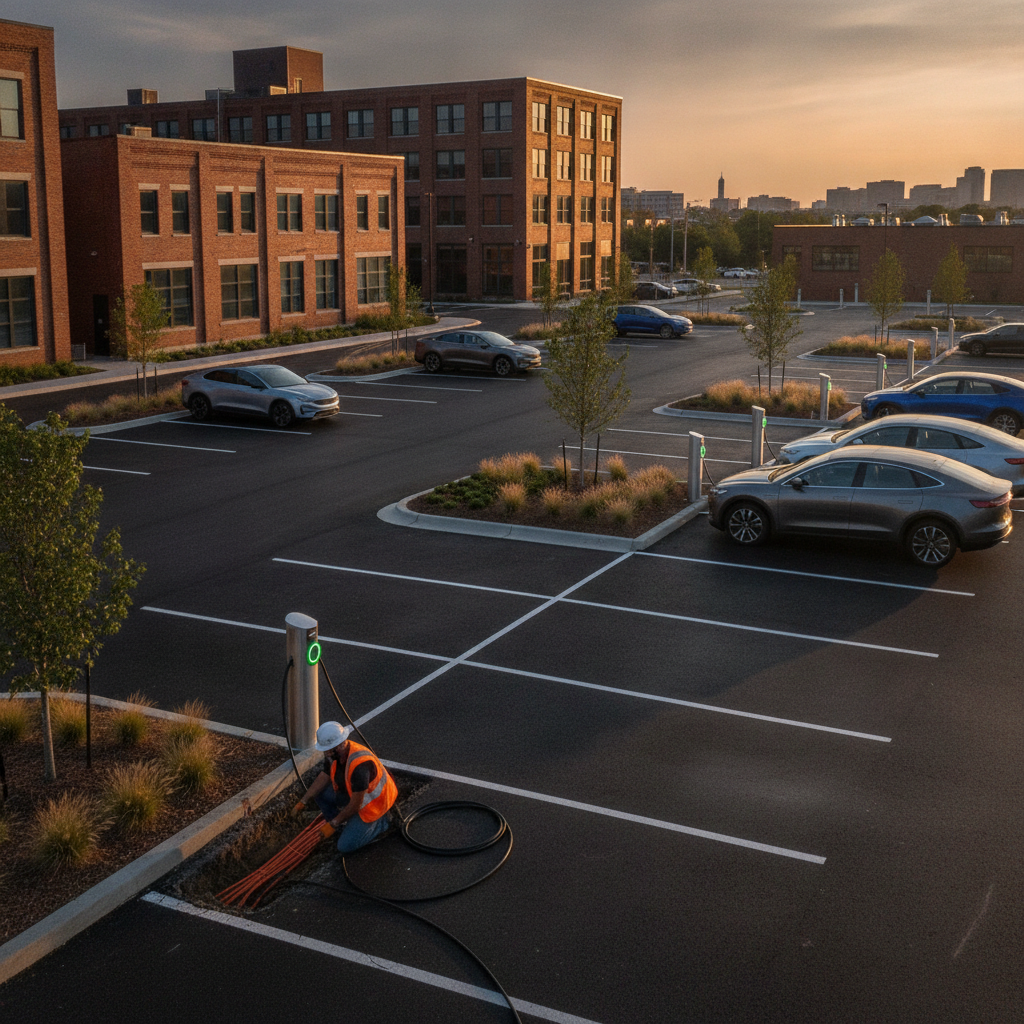
Getting power from the electrical room to the charging stalls usually means cutting or boring through the lot. This is the messiest, most disruptive part of the job, so it deserves careful sequencing. Decide early whether you can close sections of the lot at a time, and schedule work for slower business periods when possible.
Depth, spacing, and protection of conduit all matter, and requirements vary, so rely on your licensed electrician and local inspectors rather than guessing. Underground utility marking is a critical first step before any digging begins, protecting both workers and your property from damaging a gas, water, or communication line.
Plan for restoration, too. Patched asphalt, new concrete pads, and repainted striping should be part of the scope, not an afterthought. A tidy finish makes the new stalls look intentional and professional rather than like a repair zone.
Protecting Equipment From Snow and Drainage Problems
Central New York winters are hard on parking lots, and charging equipment adds new considerations. Plows push snow into piles that can bury low pedestals or damage cables and bollards. Salt spray and meltwater pooling around foundations can accelerate corrosion and create slippery approaches to the stalls.
Raise equipment on proper pads so it sits above typical snow and water levels, and add protective bollards where plow trucks or vehicles could strike it. Talk with whoever handles your snow removal about where piles are normally stacked, then keep the charging area clear of those zones. Slope and drainage should carry water away from the pedestals rather than toward them.
Cable management helps in winter as well. Retractors or holsters keep cords off the ground, out of slush, and away from freezing puddles, which extends their life and keeps drivers from fumbling with stiff, wet cables in the cold.
Lighting, Visibility, and a Safe Feel After Dark
Winter days are short, which means a large share of charging happens in the dark. If your lot is dimly lit, drivers will avoid it no matter how good the chargers are. Good lighting is both a safety feature and a marketing tool, because a bright, welcoming charging area signals that the site is active and cared for.
Evaluate your existing pole lights and check for dark gaps around the proposed stalls. Adding a fixture or two near the chargers is often a modest cost compared with the benefit. Aim for even coverage rather than harsh spots, and keep light pointed down to limit glare and spill onto neighboring properties.
Clear sightlines also help. Avoid placing chargers behind large planters, dumpster enclosures, or tall signs that hide the area from the street and the building. Open visibility discourages vandalism and makes drivers feel more comfortable plugging in after sunset.
Accessibility, Striping, and Signage Basics
A public charging space must work for everyone, including drivers with disabilities. That means thinking about accessible routes, adequate space for vehicle and wheelchair access, reachable controls, and cable lengths that do not demand awkward stretching. Standards and requirements can be detailed, so confirm the specifics with your electrician, designer, and local officials rather than relying on rules of thumb.
Clear striping and signage keep the lot organized. Mark charging stalls distinctly so drivers know they are reserved for charging, and consider posting time limits to prevent a single car from camping in a stall all day. Wayfinding signs from the entrance help first-time visitors find the stations without circling the lot.
Put simple instructions near the charger, covering how to start a session, what the pricing looks like, and who to contact if something goes wrong. A little clarity here prevents the frustration that leads to bad reviews.
Payment, Networking, and Ongoing Management
Public charging usually means you need a way to collect payment, monitor usage, and keep the equipment running. Networked chargers connect to a back-end platform that handles billing, remote diagnostics, and usage reports, while simpler units may offer free or limited access. Decide whether you want to charge drivers, offer it as a customer perk, or recover costs through a mix of both.
Reliable connectivity is essential for networked units, so test cellular or Wi-Fi coverage at the proposed location before committing. A charger that cannot reach the network is just an expensive sculpture.
Plan who will handle problems. Someone needs to respond when a unit faults, a cable is damaged, or a driver cannot start a session. Whether that is your staff, a management company, or a service contract, assigning responsibility upfront keeps your stations dependable and your visitors happy.
Budgeting Categories to Expect
Costs vary widely depending on your site, so rather than chasing a single number, think in categories. Walking through each one with your electrician helps you spot where your project will land and where you can save.
| Cost Category | What Drives It | Ways to Control It |
|---|---|---|
| Charging equipment | Power level, number of ports, networking features | Match charger speed to visitor dwell time |
| Electrical service work | Panel capacity, distance from source, service upgrades | Place stalls close to power, use load sharing |
| Trenching and pavement | Run length, surface type, restoration needs | Cluster chargers, install spare conduit once |
| Site improvements | Lighting, signage, bollards, accessibility features | Reuse existing poles and striping where possible |
| Permits and fees | Local review, inspections, utility coordination | Start approvals early and bundle submissions |
Ask about available incentives as well. Programs change over time, so confirm current options directly with the utility and relevant agencies rather than assuming a specific amount.
Permits, Timing, and Working With Your Electrician
Even a well-prepared lot needs approvals before work begins. Expect some combination of electrical permits, site or zoning review, and utility coordination, and know that timelines can stretch if documents are incomplete. Starting these conversations early, ideally while you are still finalizing the layout, keeps your project from stalling on paperwork.
Bring your photos, measurements, panel information, and a rough sketch to your first meeting. The more your electrician understands about your lot, the faster they can give an accurate scope and a realistic schedule. If you are ready to talk through your property, click here to start the conversation with a licensed local team.
Finally, plan the construction window around your business. Short, well-communicated closures, clear detour routes, and temporary signage reduce complaints and keep customers coming through your doors while the work happens.
Final Thoughts
Preparing a parking lot for public charging is mostly about doing the unglamorous groundwork well. A careful walk-through, a clear picture of your electrical capacity, thoughtful stall placement, and a plan for trenching and restoration set the foundation for a smooth project. Add weather protection, good lighting, accessible design, and straightforward signage, and you end up with a site drivers actually want to use, even on a dark February evening.
Just as important, build in room to grow. Oversized conduit, mapped expansion spaces, and a phased rollout let you start at a comfortable scale and add stations as demand rises, without tearing up fresh pavement. Think through payment, networking, and maintenance responsibilities before the first charger goes live, so the equipment stays reliable and your visitors stay happy.
Most of all, treat the project as a partnership with your electrician and local officials from day one. Share your photos, goals, and constraints early, ask about permits and incentives right away, and keep the schedule realistic. With that approach, your lot can become a genuine asset that attracts customers, supports tenants, and positions your property for where transportation in the region is heading. Take the first step by walking your lot this week and writing down what you see.