
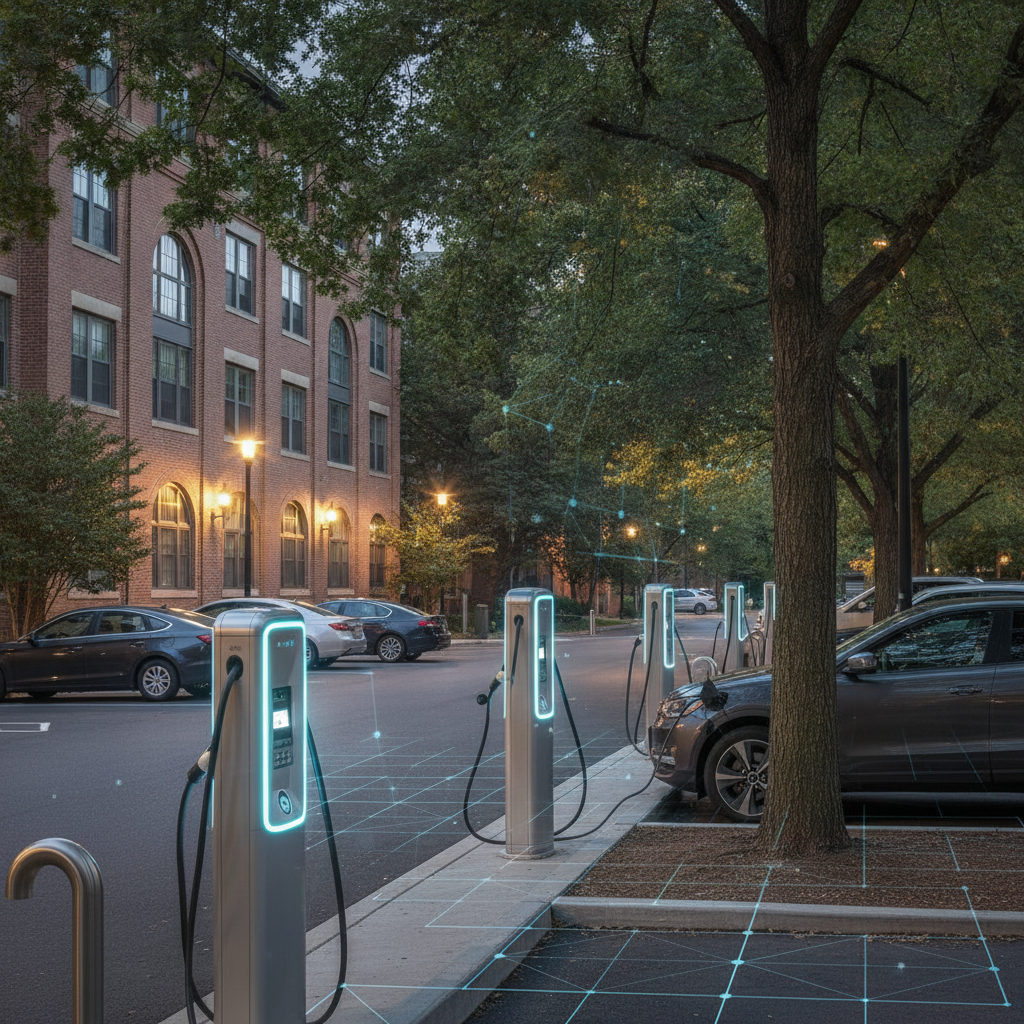
Here is a problem that catches a lot of property owners off guard. You decide to add a few EV chargers, the equipment arrives, and then someone points out that your electrical service cannot run all of them at full power at the same time. The panel was sized for lights, HVAC, and a handful of outlets, not for a row of vehicles each pulling the equivalent of a small appliance for hours. That gap between what you want and what your building can deliver is exactly where load management comes in. For any property planning EV Charging Station Installation Syracuse NY, understanding how to share available power intelligently can mean the difference between a smooth rollout and an expensive service upgrade you never needed. Load management is the set of tools and strategies that let several chargers share a limited electrical supply without tripping breakers, overloading transformers, or driving up demand charges. It is also one of the most misunderstood parts of the process. Some owners assume it is only for huge fleets, while others think it simply means buying a cheaper charger. Neither is true. This guide walks through the practical strategies, from simple circuit sharing to networked software controls, so small business owners, developers, and general readers can talk confidently with an electrician and choose an approach that fits the building, the budget, and the way people will actually use the chargers.
What Load Management Actually Means
At its simplest, load management is a way of deciding how much power each charger gets at any given moment. Instead of giving every charger a fixed, always-on slice of your electrical capacity, a managed system watches the available headroom and distributes it dynamically. When only one car is plugged in, it may charge at full speed. When four cars plug in at once, the system divides the available amperage among them so the building never exceeds its limit.
This matters because electrical service is finite. Your main panel, feeder wiring, and utility transformer all have ratings, and a continuous EV charging load counts heavily against them. Without management, you would have to size the service for the worst case where every charger runs flat out simultaneously, which is rare in practice but costly to build for. Load management lets you install more charging ports than a raw capacity calculation would allow, while still keeping everything inside safe operating limits. Many property owners who plan EV Charging Station Installation Syracuse NY find this approach opens up options they assumed were out of reach.
Why Shared Power Beats Oversizing
The traditional answer to a power shortage is to build more capacity: a bigger panel, heavier feeders, perhaps a new utility service. Sometimes that is unavoidable, but it is often the most expensive path and it frequently involves long lead times with the utility. Load management offers a cheaper and faster alternative for many sites by making better use of what already exists.
Think about how vehicles are really used. A commuter who plugs in at 8 a.m. may be done charging by midday, while another arrives at noon and leaves at five. Peak demand from every charger at once is uncommon. A managed system exploits that reality by staggering sessions and throttling output when the building is busy. The result is a lower connected-load requirement, smaller equipment, and often a reduced need for EV charging infrastructure upgrades on the service side. That does not mean upgrades are never needed, only that you should rule out smarter sharing before paying for brute-force capacity. An electrician can run a load calculation to show whether management alone solves the shortfall or whether some physical improvement is still required.
Static Versus Dynamic Load Sharing
There are two main flavors of load sharing, and the difference shapes both cost and performance. Static load sharing caps the total current available to a group of chargers at a fixed number. If you set a ceiling of 80 amps across four chargers, the system never exceeds it, dividing power evenly or by a preset rule. It is simple, reliable, and usually cheaper, because it does not need to know what the rest of the building is doing.
Dynamic load sharing goes further by monitoring the real-time electrical demand of the whole building, not just the chargers. A current sensor at the main service feeds that data to the charging controller, which then raises or lowers charger output to use whatever headroom remains. When the HVAC cycles on or a commercial kitchen fires up, chargers back off automatically. When the building quiets down, they ramp up. Dynamic systems squeeze more value from the same service, which is why they suit businesses with fluctuating loads. Static systems fit sites with predictable, steady demand. Choosing between them comes down to how variable your building load is and how much charging capacity you truly need.
Understanding Demand Charges and Your Utility Bill
For commercial properties, load management is as much about money as it is about breakers. Many commercial electric rates include a demand charge based on your highest short-interval power draw during the billing period, not just total energy used. A single afternoon when several chargers and the building’s equipment all peak together can set a high demand figure that you then pay for all month.
Managed charging helps you stay under that peak. By capping or smoothing charger output during high-demand windows, you avoid creating a spike that inflates the bill. Pairing this with off-peak scheduling, where chargers prioritize overnight or low-rate hours, can stretch savings even further. Before you commit to a design, it helps to understand the cost side of the project as a whole, and a guide like How Much Does EV Charging Station Installation Cost in Syracuse NY? can frame what to budget. Ask your utility about the specific rate structure your building is on, since the right strategy depends heavily on whether demand charges apply to your account.
Circuit Sharing Hardware Options
Not every load management strategy requires fancy software. One of the simplest approaches is a power-sharing feature built into certain charger models. Two chargers can be wired to a single shared circuit and communicate with each other so the pair never draws more than that circuit allows. When one vehicle finishes, the other automatically gets the full available amperage. This is a popular fit for small businesses and homes wanting two ports without paying for two dedicated high-amperage circuits.
Another hardware-based option is a dedicated energy management device that clamps onto the main service conductors and communicates with compatible chargers. These devices act as the brain of the system, reading actual consumption and instructing chargers accordingly. While they cost more than basic circuit sharing, they unlock true dynamic control without requiring a full cloud platform. The right pick depends on the number of ports, the compatibility between your chosen chargers, and whether you foresee expanding later. Planning for growth up front, such as running conduit large enough for future additions, usually costs far less than retrofitting later. Many owners also choose to review How Syracuse Electricians Design Lighting Layouts for Better Room Function to see how careful electrical planning pays off across other building systems too.
Networked Software and Scheduling Controls
For larger sites, networked charging platforms add another layer of control. These systems connect chargers to a central dashboard, letting a manager set power limits, create user groups, and schedule charging windows. A workplace might give employees priority during the day while limiting visitor chargers to a lower output. A multifamily building might cap each resident’s session so no single car monopolizes the supply.
Software also provides visibility. You can see how much energy each port delivers, which hours are busiest, and whether chargers are sitting idle. That data helps you refine limits over time instead of guessing. Some platforms support automatic responses to utility signals, reducing charging when the grid is strained or rates are high. The tradeoff is ongoing subscription fees and reliance on a network connection, so it is worth weighing those costs against the benefits. For a small site with two chargers, networked control may be overkill. For a lot with a dozen ports and mixed users, it often pays for itself in smoother operations and fewer support headaches.
Matching Strategy to Property Type
The best approach changes with the kind of property. A small retail shop adding two customer chargers can often rely on simple circuit sharing and a modest amperage cap. A developer building a new mixed-use project has the luxury of designing electrical capacity from scratch, but may still choose dynamic management to reduce the size of the service and lower construction cost.
Existing buildings are trickier. An older property with a nearly maxed-out panel may find dynamic load management is what makes charging possible at all, since it uses leftover capacity rather than demanding new feeders. Apartment and condo owners face the added challenge of fairness among residents, so scheduling and per-user limits become important. Hospitality and workplace sites usually have predictable arrival and departure patterns that managed charging fits well. A quick comparison can help you orient yourself before talking with an installer.
| Property Type | Typical Strategy | Main Benefit |
|---|---|---|
| Small retail or office | Circuit sharing | Low cost, simple setup |
| Older building, tight panel | Dynamic load sharing | Avoids service upgrade |
| Multifamily or condo | Networked scheduling | Fair access among users |
| Workplace or hotel | Networked plus time-of-use | Lower demand charges |
Planning for Cold Weather and Seasonal Swings
Winters in upstate New York add a wrinkle that many owners overlook. Building electrical demand climbs in cold months thanks to heating, and that is precisely when the available headroom for chargers shrinks. A load management system that looks perfect in October can feel tight in January if it was configured with a fixed assumption about spare capacity.
Dynamic systems handle this gracefully because they measure real consumption rather than assuming it. Static caps, on the other hand, should be set with the winter peak in mind. Cold also affects the vehicles themselves, since batteries can accept charge more slowly in low temperatures, which stretches sessions longer and increases the odds of overlapping demand. Residents and employees in the region often arrive with a lower state of charge after cold commutes, adding to the load at predictable times. Discuss seasonal variation with your electrician so the design reflects the worst-case months, not just the mild ones. A little foresight here prevents frustrated users and nuisance breaker trips.
Safety, Code, and Professional Sign-Off
Load management is not a way to dodge electrical safety rules. Wiring, breakers, and conductors still have to be sized correctly and installed to meet applicable electrical codes, and the management system must work within those protections. Many jurisdictions treat certain energy management systems as an accepted way to size the service, but the details, listings, and approvals vary, so a qualified electrician should confirm what applies to your project.
Permits and inspections are part of the process, and local authorities may want documentation showing how the managed limits are enforced. Failsafe behavior matters too. A good design ensures that if communication drops or a sensor fails, chargers default to a safe, reduced output instead of running unrestricted. Labeling panels and chargers clearly helps future electricians understand the setup. Treat the system like any other critical electrical equipment: have it installed, tested, and documented by a licensed professional. That documentation also makes resale, refinancing, and future expansion far easier, because the next person can see exactly how the load is controlled.
Designing for Growth Without Overbuilding
EV adoption tends to grow once chargers appear. A site that starts with two ports often wants six within a few years, so the smartest projects leave room to expand. That does not mean paying for everything today. It means running larger conduit, reserving panel space, and choosing chargers and controllers that can scale by adding units instead of replacing everything.
Load management is the key to this approach. Because the system divides available power intelligently, you can add chargers later without immediately needing a bigger service, at least up to a point. Eventually usage may justify a physical upgrade, and the data from your management platform will show when that moment arrives. Until then, you get the benefit of incremental growth, spreading cost over time. Ask your installer to sketch a phased plan with clear trigger points, such as average utilization thresholds that signal when to add capacity. That turns a vague worry about future demand into a manageable roadmap with predictable steps and budgets.
Questions to Ask Before You Commit
A short list of questions can save a lot of regret. Start with the basics about your building: how much spare capacity does the main service really have, and has anyone run a formal load calculation? Ask whether your preferred chargers support the sharing method you want, because compatibility between brands and controllers is not guaranteed.
- Does the system fail safe if a sensor or network connection is lost?
- Are there ongoing software fees, and what happens if the provider changes pricing?
- Can limits be adjusted seasonally or by time of day?
- How many additional chargers can be added before a service upgrade is needed?
- What utility incentives or rate options could reduce operating cost?
Finally, ask who will maintain and support the system after installation. Charging equipment is not set-and-forget, and having a local contact for troubleshooting, firmware updates, and adjustments keeps everything running smoothly. If you want to talk through your specific property, you can learn more here about working with a local electrical team.
Putting Your Charging Plan Together
Load management turns a hard limit into a flexible one. Rather than treating your electrical service as a wall that stops your EV plans, it lets you work with the capacity you already have and expand deliberately as demand grows. The core ideas are straightforward: measure what your building can actually spare, choose between static and dynamic sharing based on how variable your loads are, consider demand charges if you run a commercial account, and match the strategy to the way people will really use the chargers.
For many properties around Cicero and the wider Syracuse area, the winning combination is a modest number of chargers, a smart sharing method, and a layout that leaves room to add more later. Cold-weather demand, safety requirements, and permitting all deserve attention early, not as afterthoughts. The best next step is simple: get a load calculation from a licensed electrician, discuss the options in this guide, and ask for a phased plan with clear costs. Done thoughtfully, load management keeps your breakers calm, your bills predictable, and your drivers happy, while giving your property a charging setup that can grow as the neighborhood goes electric.